
1. Introduction: A Mother Beyond Ordinary
Every child grows up with stories about their parents, but some stories are powerful enough to stay for a lifetime. The phrase “My Very Educated Mother” might sound like the beginning of a mnemonic about planets, but here it is much more than that—it is the story of a woman whose intelligence, patience, and love shaped her children’s future.
Our story begins in a modest village where education was considered a luxury. In that village lived a woman named Amara, a mother of three. She was not only well-educated but also deeply passionate about sharing her knowledge. Unlike others who measured a woman’s worth by household skills, Amara was known for something far more valuable—her wisdom.
She turned her home into a little school, her children into eager learners, and her everyday life into a classroom. Through love and creativity, she proved that one educated mother could transform an entire generation.

2. The Family Background: Knowledge Rooted in Simplicity
Amara’s household was simple, yet rich with meaning. The family lived in a small clay-brick home with a thatched roof. They didn’t own much, but their home radiated warmth. In the mornings, her husband worked in the fields, while Amara took care of the household. But her true role extended far beyond cooking and cleaning—she was the teacher, mentor, and guide of her children.
The three children—Kiran, Meena, and little Arjun—were lively and full of questions. While other children of the village spent their evenings playing without purpose, Amara’s kids gathered eagerly around her as if waiting for magic. She didn’t believe in forcing them to study through textbooks alone. Instead, she made learning fun by weaving knowledge into everyday stories.
One evening, she pointed at the night sky and said, “Look at the stars. They are not just dots of light. Each one has a name, a story, a purpose. If you learn about them, you’ll learn about yourselves.” That single statement planted curiosity in their hearts. From then on, the children began to see learning not as a burden but as an adventure.
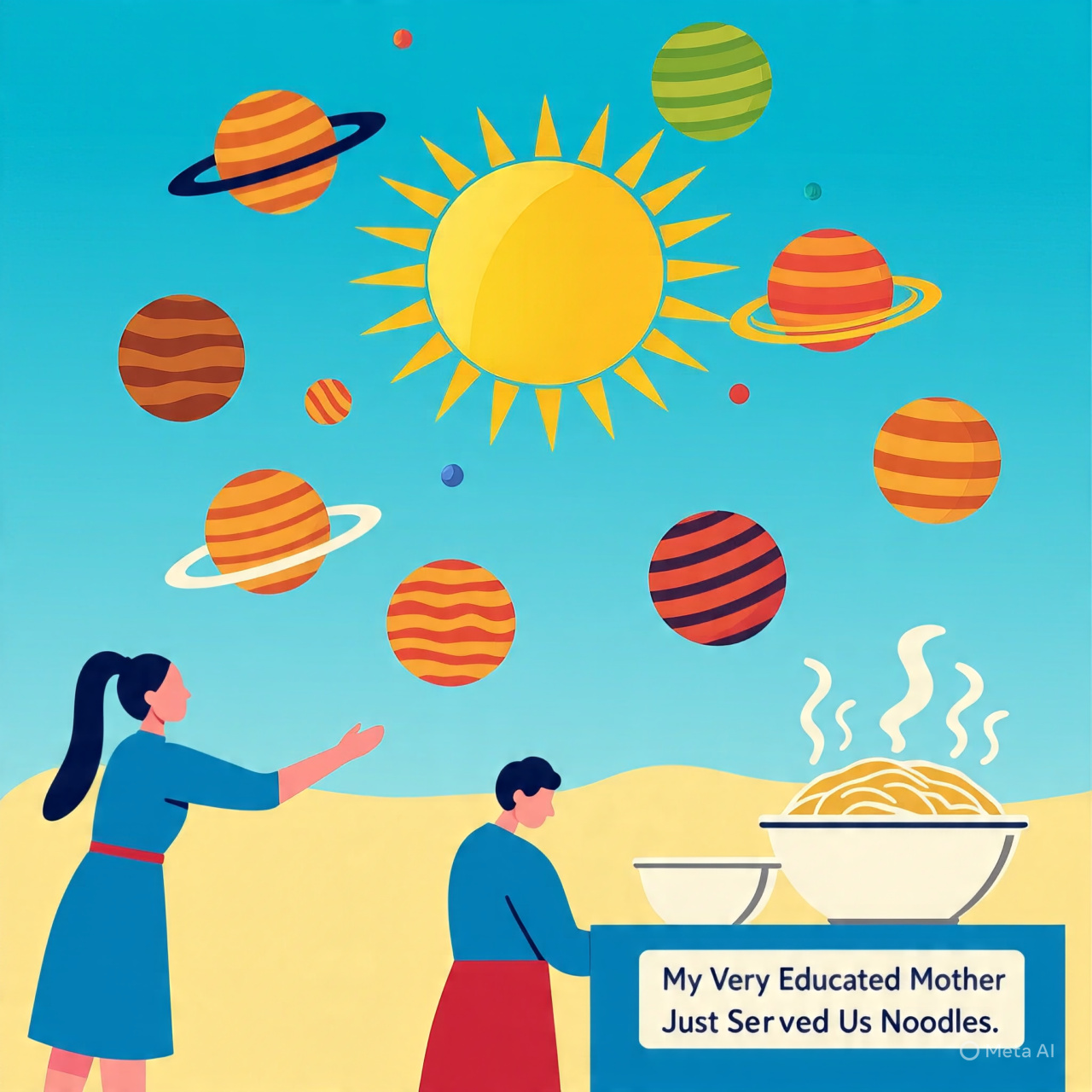
3. The Lesson of the Solar System: My Very Educated Mother Just Served Us Noodles
One day, Kiran, the eldest son, struggled with his schoolwork. His teacher had asked the students to memorize the order of the planets, but he couldn’t keep them straight. Frustrated, he turned to his mother.
Amara smiled and said, “Don’t worry. Let me show you a trick.” She picked up a stick, drew eight circles in the dust, and named each one—Mercury, Venus, Earth, Mars, Jupiter, Saturn, Uranus, Neptune. Then she recited:
“My Very Educated Mother Just Served Us Noodles.”
Each word stood for a planet:
- M – Mercury
- V – Venus
- E – Earth
- M – Mars
- J – Jupiter
- S – Saturn
- U – Uranus
- N – Neptune
The children laughed, repeating it until it stuck in their minds. It wasn’t just a sentence—it was a doorway into the universe. What seemed difficult before suddenly became fun.
That day, the children realized something extraordinary: education is not about memorizing words from books but about understanding through imagination. Their mother had gifted them not just knowledge but also the joy of learning.
4. A Day in Their Lives: Wisdom Beyond the Classroom
The real beauty of Amara’s teaching was how naturally it blended into daily life. On a bright Sunday morning, she decided to take her children to the river. As they walked, she pointed at the trees, the insects, and the flowing water, explaining their connection.
“Do you see this river?” she asked. “It never stops flowing, no matter how many rocks lie in its path. That’s how life should be. Obstacles will come, but like the river, you must continue moving forward.”
The children listened with wide eyes. Even little Arjun, though too young to fully grasp her words, sensed the weight of her wisdom.
Later that evening, during a village gathering, a teacher quizzed the children about the solar system. While most children hesitated, Amara’s kids proudly stood up and recited the planets in perfect order. The crowd cheered, and the teacher was astonished. “Who taught you this?” he asked. With innocent smiles, they pointed at their mother.
That moment wasn’t just a victory for the children—it was proof of what a mother’s love and knowledge could achieve.
5. The Lasting Impact of Her Lessons
As time passed, the children grew older, but the lessons from their mother remained etched in their hearts. Kiran became fascinated with science, Meena developed a love for literature, and Arjun dreamed of becoming an engineer. All of them credited their success to the foundation laid by their mother.
Her teachings weren’t just about planets or rivers. She instilled values of resilience, curiosity, and kindness. She showed them that knowledge wasn’t limited to classrooms—it was in the stars, the soil, the water, and even the meals they shared together.
When the children left for higher studies, they carried with them not just academic knowledge but also life skills their mother had carefully nurtured. Her famous phrase—“My Very Educated Mother Just Served Us Noodles”—became more than a mnemonic. It became a reminder of her guidance, patience, and endless love.
Amara’s story is not just about one mother; it’s about the power of educated women everywhere. A mother with knowledge is like a candle that lights up not just her home but the path for generations to come.
6. The Role of Mothers in Education
Across cultures and centuries, mothers have played the first and most important role in shaping a child’s mind. A child’s first teacher is not their school instructor but their mother. From teaching the first words to introducing moral values, mothers lay the foundation of knowledge and wisdom.
Amara embodied this role beautifully. She believed that education did not stop with reading and writing—it was about curiosity, observation, and application. Every moment became an opportunity to teach: counting mangoes while preparing a meal, explaining gravity when fruit fell from a tree, or narrating stories that carried moral lessons.
Science agrees with this idea. Studies show that children who grow up in environments where mothers are engaged in their education develop stronger problem-solving skills and emotional intelligence. Amara proved this in practice. Her children weren’t just top of their class academically; they were thoughtful, confident, and kind.
In a world where many still underestimate the value of women’s education, her story shouts a truth: when you educate a mother, you educate an entire generation.
7. Why Knowledge Shared by Mothers Lasts Forever
There is something unique about the way mothers teach. Lessons from school may fade, but what mothers teach often stays for a lifetime. Why? Because their lessons are wrapped in love, repeated daily, and reinforced through real-life examples.
Amara’s children never forgot the solar system not only because of the mnemonic but also because of how she presented it—with warmth, patience, and humor. The phrase wasn’t written in a textbook; it was spoken with affection under a starry sky. That emotional connection made it unforgettable.
Mothers also have the ability to personalize lessons. Unlike a classroom of fifty children, a mother focuses on each child’s strengths and weaknesses. She knows when her child is tired, when they are curious, and when they need encouragement. This personal attention makes her teaching powerful.
Think of it like carving words into wet cement. School may write with chalk on a blackboard, but a mother’s words are engraved deeply into the heart and mind. Amara’s lessons about planets, rivers, and perseverance became part of her children’s identity—guiding them long after they left home.

8. The Solar System Lesson: From Childhood to Adulthood
Years later, when Kiran became a science teacher himself, he often smiled remembering his mother’s phrase. Whenever he taught his students the order of the planets, he repeated the same words:
“My Very Educated Mother Just Served Us Noodles.”
The students laughed, just like he had as a child, and soon enough, they too remembered the planets easily. What Amara had given him was more than knowledge—it was a teaching method that continued to impact new generations.
Meanwhile, Meena used her mother’s lessons in her writing. She became a poet, often describing the universe in metaphors that echoed her childhood memories. One of her most famous lines read, “My mother did not just serve us food, she served us galaxies of wisdom.” Readers across the region resonated with her words, though few knew the story behind them.
Arjun, the youngest, grew up to become an engineer. Whenever he faced challenges in his career, he remembered his mother’s river analogy: “Like water, keep flowing no matter the obstacles.” That one lesson carried him through countless struggles.
The solar system mnemonic may have started as a simple school trick, but in reality, it shaped careers, passions, and philosophies. That is the magic of an educated mother—her teachings ripple through time.
9. The Cultural Importance of Educated Mothers
Amara’s story is not unique to her family alone. Around the world, history is filled with examples of mothers whose education influenced great leaders, thinkers, and innovators.
- Abraham Lincoln once said, “All that I am, or hope to be, I owe to my angel mother.” His mother, though not formally schooled, instilled in him the value of reading and moral integrity.
- Thomas Edison’s mother withdrew him from school after teachers called him “unfit to learn.” She educated him at home, nurturing his curiosity. Edison went on to become one of the greatest inventors in history.
- In many African cultures, mothers are considered the “first university,” as they pass down knowledge, traditions, and survival skills to their children.
Educated mothers like Amara are cultural treasures. They create ripples of progress not only within their homes but also within their communities. A child influenced by an educated mother grows into a citizen who contributes to society, whether through science, art, leadership, or kindness.
Thus, the phrase “My Very Educated Mother” is not just a mnemonic—it is a celebration of the role mothers play in shaping humanity’s future.
10. How Education Transforms Parenting
Parenting is not only about providing food, clothing, and shelter—it is also about preparing children for the world. An uneducated parent may love their children deeply, but an educated parent has the tools to guide them more effectively.
Amara understood this well. She balanced discipline with kindness, lessons with laughter. Her children grew up not fearing her but admiring her. They didn’t study because they had to; they studied because she made it enjoyable.
For example, instead of scolding them for mistakes, she turned errors into teaching moments. When Arjun broke a clay pot, instead of punishing him, she said, “Do you see how the cracks spread from one point? That’s how small mistakes in life can grow if we don’t fix them early.” That lesson stuck with him longer than any punishment ever could.
Education also gave her confidence. In community meetings, while most women stayed silent, Amara spoke boldly about the importance of sending children—especially daughters—to school. Her voice inspired other mothers, slowly changing the mindset of the village.
Parenting shaped by education is like planting seeds in fertile soil. The harvest may take years, but when it comes, it feeds not just one family but entire communities.

11. The Emotional Bond Between Mother and Children
Education is powerful, but without love, it feels empty. What made Amara’s lessons unforgettable wasn’t just her knowledge—it was the emotional bond she shared with her children.
Every evening, after a long day of chores and responsibilities, she still found the energy to sit with her children. She never treated teaching as a duty; instead, it was her way of expressing love. She didn’t raise her voice when they struggled, nor did she compare them to others. Instead, she encouraged them by saying, “You may not get it today, but tomorrow you will—and when you do, you’ll be proud of yourself.”
That emotional connection gave the children confidence. They never feared failure because their mother had taught them that mistakes were part of learning. This bond was like sunlight nurturing a garden—without it, knowledge would wither. With it, learning blossomed into lifelong curiosity.
Even when the children grew into adults, they felt her presence guiding them. Kiran, as a teacher, often told his students, “When I explain things to you, I imagine I am speaking the way my mother spoke to me.” That shows the deep emotional imprint an educated mother can leave behind.
12. Teaching Beyond Books: Life Lessons That Mattered
Amara’s wisdom went far beyond school subjects. She believed that real education was about life itself. Her children learned not only math and science but also resilience, kindness, and responsibility.
For example:
- When they fought over toys, she reminded them, “Knowledge grows when shared, and so does love.”
- When they wasted food, she told them about farmers who worked tirelessly under the sun, teaching them gratitude.
- When they were upset about failures, she said, “Even the moon disappears some nights, but it always comes back. So will you.”
These life lessons had as much weight as any academic subject. Meena, the daughter, often said that her mother’s teachings became the compass that guided her through adulthood. Whenever she faced ethical dilemmas, she would pause and ask, “What would Mother say?”
In truth, mothers like Amara are more than teachers—they are philosophers of everyday life. Their lessons seep into children’s choices, relationships, and even their careers. And the beauty is, children don’t realize the value of those lessons until years later, when life tests them.
13. The Legacy of an Educated Mother
Legacies are not always built with wealth or property. Sometimes, the greatest inheritance a parent leaves behind is wisdom. Amara’s legacy lived in her children’s success, but even more so in their character.
Kiran carried her torch in education, teaching hundreds of students. Meena spread her mother’s philosophy through poetry, touching countless hearts. Arjun built bridges and roads that improved lives, often recalling his mother’s lessons about perseverance.
But perhaps the most profound part of her legacy was how they, in turn, taught their own children. They didn’t just pass down facts—they passed down the method of learning through love, patience, and imagination. When Kiran’s daughter struggled with multiplication, he told her a funny rhyme, just like his mother once did with the planets. When Meena’s son felt discouraged, she reminded him of the river story.
This is how an educated mother’s influence travels through generations, like ripples spreading endlessly across a pond. Even after Amara was gone, her voice lived on in the wisdom of her children and grandchildren.

14. How the Mnemonic Lives On in Generations
The phrase “My Very Educated Mother Just Served Us Noodles” became a family treasure. It wasn’t just a memory aid—it was a story they told again and again.
At family gatherings, whenever someone mentioned planets, laughter filled the air as they recalled how their mother taught them. It became a symbol of their bond, a reminder that even the simplest phrase could hold a universe of meaning.
Interestingly, the mnemonic also traveled beyond the family. Kiran’s students, Meena’s readers, and even Arjun’s colleagues used it. What began in a dusty courtyard with a stick and circles drawn on the ground eventually reached classrooms, poems, and offices far away.
It is said that knowledge spreads like fire when shared. Amara’s little teaching tool had become a flame that lit the minds of people she never even met. That is the magic of a mother’s wisdom—it doesn’t stop at her doorstep; it travels across generations and geographies.
15. Why Every Child Needs an Educated Mother
Amara’s story highlights a truth that the world often forgets: educating mothers is one of the most powerful investments society can make. An educated mother doesn’t just raise educated children—she raises thinkers, leaders, and compassionate human beings.
Consider this:
- Educated mothers are more likely to send their children to school.
- They teach health, hygiene, and values that improve family well-being.
- They break cycles of poverty by equipping children with knowledge and ambition.
- They inspire equality by showing daughters that women can be both nurturing and intelligent.
For Amara’s children, education wasn’t just about grades; it was about having a role model who believed in them. Her presence gave them confidence, her knowledge gave them tools, and her love gave them purpose.
Every child deserves such a foundation. That’s why societies that prioritize women’s education progress faster—they create generations of learners, dreamers, and doers.
Amara may have been one mother in a small village, but her story echoes a universal truth: behind every educated child, there is an educated mother.